
IB Diploma Programme · Group 4 — Sciences

Sports, Exercise and Health Science (SEHS)

Standard Level · SL: 150 hours · DP Year 1 (2027) and DP Year 2 (2028)

Group
Group 4 — Sciences
Level offered
Standard Level (SL)
Teaching hours
SL: 150 hours
IB syllabus
Current DP syllabus, first examined 2026

Course description

Sports, exercise and health science (SEHS) is concerned with the scientific study of human physiology, biomechanics and psychology as they relate to physical and mental health and performance. The course is organised around three overlapping themes and is grounded in scientific inquiry, including field work and laboratory investigation.

Course structure

  • A. Exercise Physiology and Nutrition of the Human Body
  • B. Biomechanics
  • C. Sports Psychology and Motor Learning
  • Experimental programme: practical work, collaborative sciences project, scientific investigation

Students who should consider this course

This course suits students with a genuine interest in human performance, health science, physiology and psychology, and is useful preparation for further study in exercise and sports science, physiotherapy, allied health or medicine.

Assessment at a glance

ComponentWeighting %
Paper 1 — Multiple-choice and data-based questions (external)36
Paper 2 — Short-answer and extended-response questions (external)40
Scientific investigation (internal)24

External examinations

External assessment consists of two written papers sat in the November session. The internally assessed scientific investigation is an open-ended task reported as a written report of up to 3,200 words.
Subject presentation

Slide 1 of 11
Slide 1 of 11Use ← → keys, or click a slide

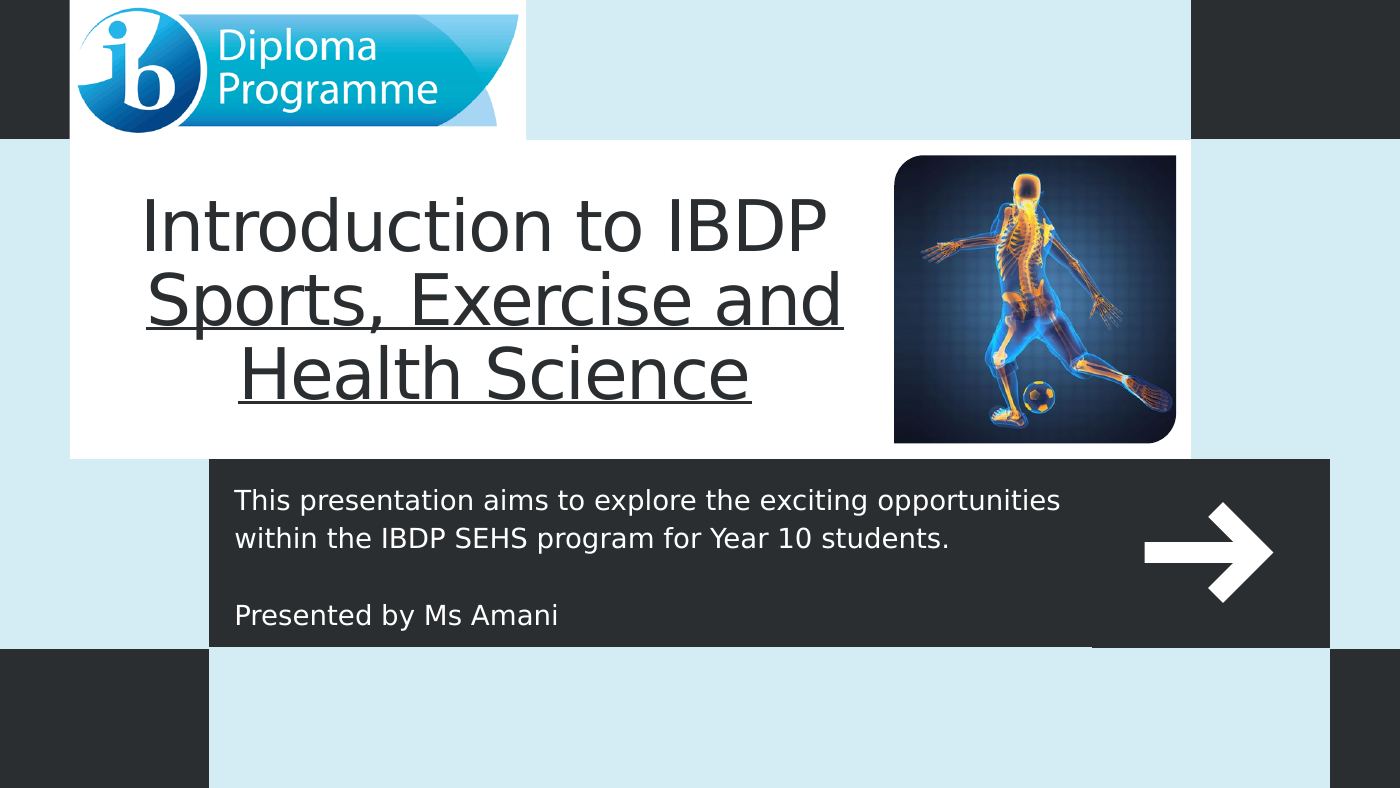
Introduction to IBDP Sports, Exercise and Health Science, presented by Ms Amani (PDHPE Department). Time-allocation, curriculum-model and assessment-model slides are image-based and shown in the slide viewer.
Text transcript of the slides (8 slides)
Slide 1

Introduction to IBDP Sports, Exercise and Health Science

  • Exploring the opportunities within the IBDP SEHS program for Year 10 students.
  • Presented by Ms Amani.
Slide 2

Sports, Exercise and Health Science

  • SEHS is a human science driven by curiosity about what makes humankind flourish, both physically and mentally.
  • Spanning multiple disciplines, it is the formal study of the impacts of physiology, biomechanics and psychology on human health and athletic performance.
  • Students undertake practical experimental investigations in both laboratory and field settings, acquiring the knowledge and understanding necessary to apply scientific principles to the critical analysis of humankind and its sporting endeavours.
Slide 3

Course overview

  • The course incorporates the disciplines of anatomy and physiology, biomechanics, psychology and nutrition.
  • Students cover a range of core and option topics, and carry out practical (experimental) investigations in both laboratory and field settings.
  • It offers a deeper understanding of the issues related to sports, exercise and health in the 21st century and addresses the international dimension and ethics related to both the individual and global context.
Slide 4

Course aims

  • Develop conceptual understanding, allowing connections between different areas of the subject and other sciences.
  • Acquire and apply a body of knowledge, methods, tools and techniques that characterise science.
  • Develop the ability to analyse, evaluate and synthesise scientific information and claims.
  • Approach unfamiliar situations with creativity and resilience.
  • Design and model solutions to local and global problems in a scientific context.
  • Appreciate the possibilities and limitations of science; develop technology skills; communicate and collaborate effectively.
  • Develop awareness of the ethical, environmental, economic, cultural and social impact of science.
Slide 5

Course time allocations

  • The IBDP SEHS program offers distinct time allocations for HL and SL — 150 hours at SL and 240 hours at HL — ensuring a comprehensive understanding of scientific concepts tailored to each level’s depth of study.
Slide 6

Curriculum and assessment model

  • See the slide viewer for the curriculum model overview and assessment model.
Slide 7

TOK, EE and CAS opportunities

  • TOK — students evaluate knowledge claims by exploring questions concerning their validity, reliability, credibility and certainty, as well as individual and cultural perspectives on them.
  • EE — independent research on a focused topic generated from the SEHS course or beyond, developing research, thinking, self-management and communication skills.
  • CAS — many opportunities to link science, sport and health concepts to practical experiences; CAS experiences may ignite passion for topics inside the SEHS classroom.
Slide 8

Why should you study SEHS?

  • You aspire to a career in health and allied health or athletics.
  • You want to study a subject that goes hand in hand with other subjects.
  • You enjoy tying theory and practice together through scientific inquiry and hands-on experiments.
  • You don’t know what you want to do — and SEHS sounds interesting.

Posters

Slide 1 of 2
Slide 1 of 2Use ← → keys, or click a slide

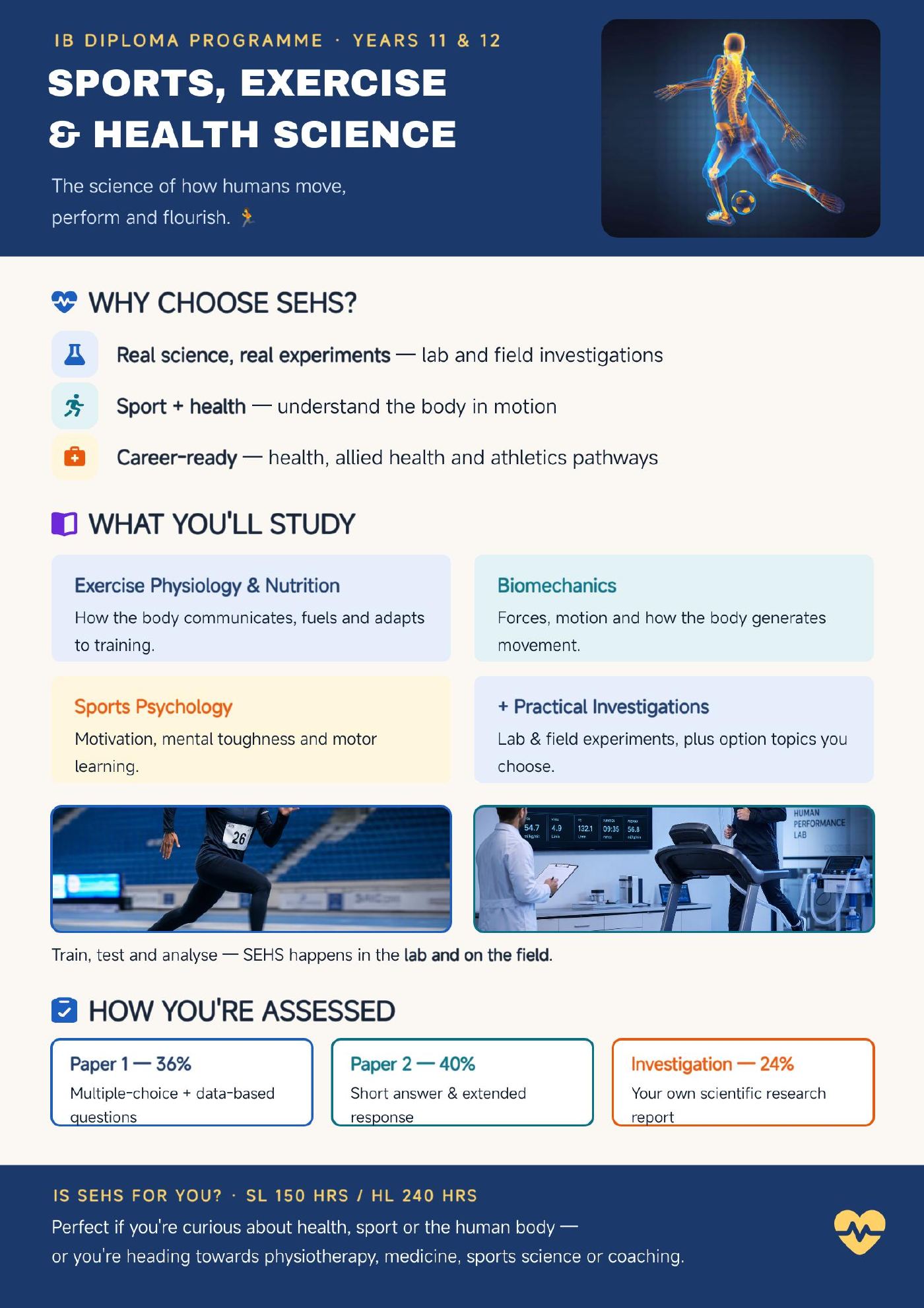
Sport, Exercise and Health Science posters (PDHPE Department).