
IB Diploma Programme · Group 4 — Sciences

Chemistry

Standard Level · SL: 150 hours · DP Year 1 (2027) and DP Year 2 (2028)

Group
Group 4 — Sciences
Level offered
Standard Level (SL)
Teaching hours
SL: 150 hours
IB syllabus
Current DP syllabus, first examined 2025

Course description

Chemistry is concerned with identifying patterns that explain matter at the microscopic level, allowing its behaviour to be predicted and controlled at the macroscopic level. The subject emphasises the development of representative models and explanatory theories, supported by learning through scientific inquiry in the classroom and laboratory.

Course structure

  • Structure 1: Models of the Particulate Nature of Matter
  • Structure 2: Models of Bonding and Structure
  • Structure 3: Classification of Matter
  • Reactivity 1: What Drives Chemical Reactions?
  • Reactivity 2: How Much, How Fast and How Far?
  • Reactivity 3: What Are the Mechanisms of Chemical Change?
  • Experimental programme: practical work, collaborative sciences project, scientific investigation

Students who should consider this course

This course suits students considering study or careers in medicine, pharmacy, chemical or biomedical engineering, forensic science, materials science or related physical and biological sciences.

Assessment at a glance

ComponentWeighting %
Paper 1 — Multiple-choice and data-based questions (external)36
Paper 2 — Short-answer and extended-response questions (external)44
Scientific investigation (internal)20

External examinations

External assessment consists of two written papers sat in the November session. The internally assessed scientific investigation is an open-ended task reported as a written report of up to 3,000 words.
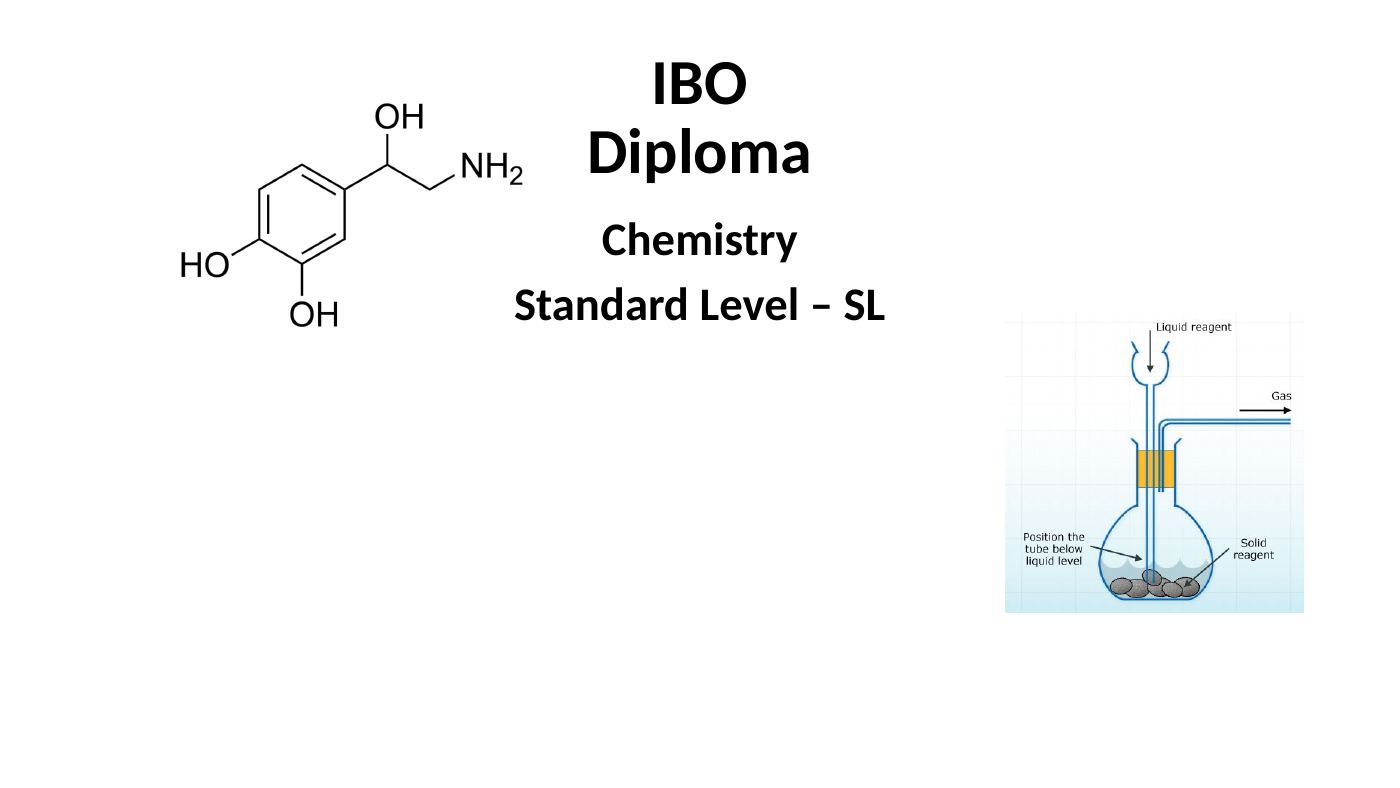
Subject presentation

Slide 1 of 11
Slide 1 of 11Use ← → keys, or click a slide

IB Chemistry — Standard Level subject presentation (Science Department). Syllabus-outline and assessment-outline slides are image-based and shown in the slide viewer.

Text transcript of the slides (9 slides)
Slide 1

IB Diploma — Chemistry, Standard Level

  • Group 4 — Sciences
Slide 2

What is the purpose of studying chemistry?

  • Chemistry is primarily concerned with identifying patterns that allow us to explain matter at the microscopic level. This then allows us to predict and control matter’s behaviour at a macroscopic level.
  • The subject therefore emphasises the development of representative models and explanatory theories, both of which rely heavily on creative but rational thinking.
  • The development of generalised rules and principles also plays an important part in knowledge production.
Slide 3

Course outline — Year 1

  • Term 1 — Atomic structure and the periodic table (Structure 1.1–1.3, 3.1; Reactivity 3.4): the fundamental concepts that underpin bonding, reactions and the periodic table.
  • Terms 1–2 — Chemical bonding and molecular structure (Structure 2.1–2.4): how atoms bond and form molecules, the groundwork for compounds, reactions and molecular properties.
  • Term 2 — Chemical reactions, stoichiometry and gas laws (Structure 1.4–1.5; Reactivity 2.1): equations, reaction types, the mole concept and stoichiometric calculations.
  • Term 3 — Thermodynamics, chemical energetics and kinetics (Reactivity 1.1–1.4, 2.2); the collaborative sciences project is introduced.
  • Term 4 — Chemical equilibrium (Reactivity 2.3): equilibrium constants and Le Chatelier’s principle; the internal assessment is introduced.
Slide 4

Course outline — Year 2

  • Term 1 — Acids and bases (Reactivity 3.1, 3.2, 3.4): Arrhenius and Brønsted–Lowry definitions, the pH scale and acid–base reactions, including titrations.
  • Term 2 — Electrochemistry (Structure 3.1; Reactivity 3.2): electrochemical cells, redox reactions and electrolysis, with applications in electroplating and batteries; the internal assessment is concluded.
  • Term 3 — Organic chemistry and analytical techniques (Structure 2.4, 3.2; Reactivity 3.2–3.4): hydrocarbons, functional groups, isomerism, nomenclature, reactions and basic synthesis.
Slide 5

Collaborative sciences project

  • An interdisciplinary sciences project addressing real-world problems that can be explored through the sciences.
  • Students integrate factual, procedural and conceptual knowledge developed through the study of their disciplines.
  • It supports the development of approaches-to-learning skills, including team-building, negotiation and leadership, and an appreciation of the environment and the social and ethical implications of science and technology.
Slide 6

Internal assessment — the scientific investigation

  • Duration 10 hours · weighting 20%. The IA requirement is the same for biology, chemistry and physics.
  • An open-ended task in which the student gathers and analyses data in order to answer their own formulated research question.
  • Assessed through a written report with a maximum of 3,000 words.
Slide 7

Skills in chemistry

  • Tools — Tool 1 experimental techniques; Tool 2 technology; Tool 3 mathematics.
  • Inquiry process — Inquiry 1 exploring and designing; Inquiry 2 collecting and processing data; Inquiry 3 concluding and evaluating.
Slide 8

Assessment outline — SL

  • External assessment (3 hours) — 80%: Paper 1 (1 hour 30 minutes, 36%) — Paper 1A multiple-choice and Paper 1B data-based questions, 55 marks; Paper 2 (1 hour 30 minutes, 44%) — short-answer and extended-response questions, 50 marks.
  • Internal assessment (10 hours) — 20%: the scientific investigation, 24 marks, internally assessed and externally moderated.
Slide 9

Purpose of internal assessment

  • Internal assessment is an integral part of the course and is compulsory for both SL and HL students.
  • It enables students to demonstrate the application of their skills and knowledge, and to pursue their personal interests, without the time limitations of written examinations.
  • It should, as far as possible, be woven into normal classroom teaching rather than conducted as a separate activity after the course has been taught.