IB Diploma Programme · Group 6 — The Arts

Visual Arts

Standard Level · SL: 150 hours · DP Year 1 (2027) and DP Year 2 (2028)

Group
Group 6 — The Arts (or a second subject from Groups 1–5)
Level offered
Standard Level (SL)
Teaching hours
SL: 150 hours
IB syllabus
Current DP syllabus, first examined 2016

Course description

Visual arts encourages students to challenge their own creative and cultural expectations and boundaries. Students develop analytical skills in problem-solving and divergent thinking while working towards technical proficiency and confidence as art-makers, exploring and comparing visual arts from different perspectives and contexts.

Throughout the course, students maintain a visual arts journal documenting their process; while not directly assessed, it underpins the coursework submitted for assessment.

Course structure

  • Visual Arts in Context
  • Visual Arts Methods
  • Communicating Visual Arts
  • Maintenance of a visual arts journal throughout the course

Students who should consider this course

This course suits students with a strong interest in art, design or visual culture, and is useful preparation for further study in visual arts, design, architecture, media or related creative fields.

Assessment at a glance

ComponentSL %HL %
Art-Making Inquiry Portfolio (external)2020
Connection study (external)4040
Resolved Artworks (internal)4040

The Visual Arts Department’s presentation reflects the updated DP Visual Arts course (first assessment 2026): Art-Making Inquiries Portfolio 40% SL / 30% HL; Connections Study (SL) 20% or Artist Project (HL) 30%; Resolved Artworks (internal) 40%. The Academy will confirm which weightings apply to the 2027 cohort.

External examinations

All work is submitted digitally — there is no written examination. The externally assessed comparative or connections study examines and compares artworks by at least two different artists, submitted as a set of annotated screens. HL students submit a larger body of work than SL students.
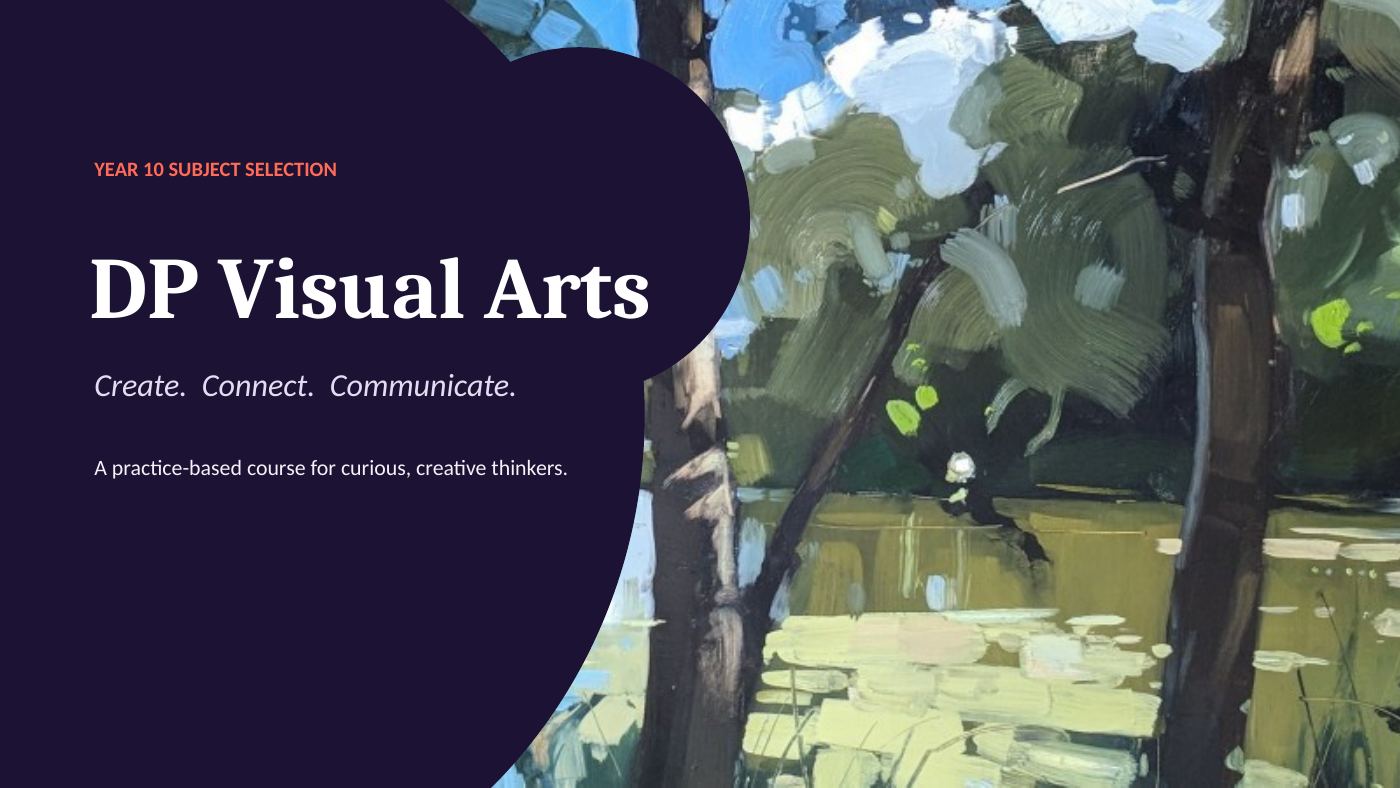
Subject presentation

Slide 1 of 15
Slide 1 of 15Use ← → keys, or click a slide

Year 10 Subject Selection — DP Visual Arts (Visual Arts Department). Student work samples are image-based and shown in the slide viewer.

Text transcript of the slides (12 slides)
Slide 1

DP Visual Arts

  • Create. Connect. Communicate.
  • A practice-based course for curious, creative thinkers.
Slide 2

The big picture — what is DP Visual Arts?

  • A hands-on, practice-based course where you work like a real artist: your classroom becomes a studio, and your own ideas drive the work. Over two years you build a personal body of art while learning to think, research and communicate like a young creative professional.
  • Create — experiment with materials, forms and creative strategies to develop your own visual language.
  • Connect — investigate artworks from different times, places and cultures, and situate your own work in context.
  • Communicate — curate, present and exhibit your art, sharing your intentions with real audiences.
Slide 3

Why choose Visual Arts?

  • Think and make like an artist — develop as an imaginative, skilled creator with real technical competence.
  • Build transferable skills — critical thinking, independent research and problem-solving, valuable in any DP subject or career.
  • Open doors beyond the arts — visual thinking, portfolio-building and self-directed inquiry support pathways in design, architecture, marketing, media, psychology and more.
  • Grow in confidence — take risks, embrace mistakes as discoveries, and develop resilience through an authentic creative process.
Slide 4

Your classroom becomes a studio

  • Art-making as inquiry: you follow your own lines of inquiry, guided by questions that matter to you.
  • Investigate — explore materials, artists and ideas. Generate — develop new possibilities through experimentation. Refine — review, get feedback and improve. Resolve — bring artworks to a meaningful point of completion. Curate and situate — present your work and connect it to context.
  • No single path: some students explore fewer forms in greater depth; others range more broadly. Both are equally valid.
Slide 5

Skills you’ll build

  • Thinking — creative and generative thinking, embracing mistakes as discovery.
  • Communication — visual language plus confident writing about your art.
  • Social — giving and receiving critique; learning alongside peers.
  • Self-management — time management, resilience, ownership of your practice.
  • Research — investigating artists, contexts and ideas with rigour.
Slide 6

Standard Level or Higher Level?

  • Every student engages in art-making as inquiry and meets the same assessment objectives; HL students complete additional, deeper and broader practical and theoretical work.
  • SL — 150 teaching hours: art-making inquiries portfolio; connections study; resolved artworks (5 works).
  • HL — 240 teaching hours: art-making inquiries portfolio; artist project (stand-alone); selected resolved artworks (5 of 8+ works, with 5 artwork texts).
Slide 7

How you’re assessed

  • Assessment is digital, criterion-based and built into your creative process. Three tasks — no exams.
  • External assessment 60% (marked by IB examiners); internal assessment 40% (marked by your teacher, moderated by the IB).
  • Task 1 Portfolio — 40% SL / 30% HL. Task 2 Connections study (SL) 20% / Artist project (HL) 30%. Task 3 Resolved artworks (IA) — 40% SL and HL.
Slide 8

Task 1 — Art-Making Inquiries Portfolio (SL and HL)

  • You curate visual evidence of your own investigations, discoveries and creations — showing how you explored a variety of art-making forms and creative strategies to develop your personal visual language.
  • Criteria: A exploration and experimentation (8 marks); B practical investigation of other artists (8); C lines of inquiry (8); D critical review (8) — 32 marks total.
  • Format: up to 15 screens (PDF), maximum 3,000 words, separate source list. Weighting SL 40% · HL 30%.
Slide 9

Task 2 — Connections Study or Artist Project

  • SL Connections Study (20%) — situate one of your resolved artworks: how does it connect to your own context and to at least two artworks by different artists? Up to 10 screens, max 2,500 words, 24 marks.
  • HL Artist Project (30%) — a stand-alone project of your choice: propose, connect, refine through dialogue, then realise and situate an artwork for a real or potential audience. Up to 12 screens plus a 3-minute video, max 2,500 words, 40 marks.
Slide 10

Task 3 — Internal assessment: your coherent body of work

  • Marked by your teacher and moderated by the IB — where your two years of practice come together into a polished, coherent set of five artworks.
  • SL Resolved Artworks — submit 5 resolved artworks with a written rationale (max 700 words); assessed on coherence, conceptual realisation and technical resolution — 32 marks.
  • HL Selected Resolved Artworks — select 5 from a wider production of 8+ artworks, with rationale and 5 artwork texts (max 1,000 words); also assessed on understanding of artistic context — 40 marks.
Slide 11

Visual Arts and the DP core

  • Theory of Knowledge — explore artistic practice as a way of knowing: how is meaning made and interpreted?
  • Extended Essay — investigate a visual arts topic of personal interest through independent research.
  • CAS — exhibit, create murals or run art-based projects that give back to your community.
Slide 12

Is Visual Arts for you?

  • You enjoy experimenting and aren’t afraid to make mistakes.
  • You like having ownership over your own projects.
  • You’re curious about ideas, culture and the wider world.
  • You want a creative outlet that still builds academic skills.
  • You’re willing to reflect, take feedback and keep improving.
  • No prior experience needed — teachers build foundational skills first, then support you as you grow more independent.